At the beginning of my sophomore year I one day noticed my friend on a web page I had never seen before. When I asked her about it she quickly introduced me to the world of blogging. The sight was Xanga, and within about a 2 month period about 7 of my real close friends had developed sights of their own. It was like nothing we had ever experienced. We were free, free to express our emotions and to communicate with each other at all times of the day without tying up our home phones (none of us at this point had cell phones). We blogged about our love lives, friendships, disappointments, exciting events, family, pets… the list went on and on. It was the period during which our friendships were the closest. It was easy to comment suggestions and celebrations on other’s pages, and it was easy to express your emotions when you knew that somewhere one of your friends was going to log on and share them with you. Maybe it was our adolescence, or maybe it was simply the thought that something in our lives was simple, but blogging became the center of our world. As we got older, however, our posts became less frequent and our friendships began to unwind themselves. By the time the end of my senior year Xanga was just a place we visited for a melancholic reminiscence or for a laugh about the things we toiled over in our earlier youth. This experience makes me wonder about all the things we were infatuated with in our youth that diminished in value in our life as we age.
Wednesday, October 17, 2007
Post 9: Xanga Reminiscence
At the beginning of my sophomore year I one day noticed my friend on a web page I had never seen before. When I asked her about it she quickly introduced me to the world of blogging. The sight was Xanga, and within about a 2 month period about 7 of my real close friends had developed sights of their own. It was like nothing we had ever experienced. We were free, free to express our emotions and to communicate with each other at all times of the day without tying up our home phones (none of us at this point had cell phones). We blogged about our love lives, friendships, disappointments, exciting events, family, pets… the list went on and on. It was the period during which our friendships were the closest. It was easy to comment suggestions and celebrations on other’s pages, and it was easy to express your emotions when you knew that somewhere one of your friends was going to log on and share them with you. Maybe it was our adolescence, or maybe it was simply the thought that something in our lives was simple, but blogging became the center of our world. As we got older, however, our posts became less frequent and our friendships began to unwind themselves. By the time the end of my senior year Xanga was just a place we visited for a melancholic reminiscence or for a laugh about the things we toiled over in our earlier youth. This experience makes me wonder about all the things we were infatuated with in our youth that diminished in value in our life as we age.

Sunday, October 14, 2007
Post 8: Response to Nebraskans dropping land lines in favor of cell phones
America is quickly becoming “the cell phone nation”. And although I knew that the number of cell phones in the world was growing, I was surprised when I read the article that in Nebraska this growth is being countered by a loss in the number of landlines. I guess it was fairly naïve of me to be surprised by this information, but I grew up in a small town where cell phone reception is labeled sketchy at best. I did some research and a basic phone line in Nebraska can be expected to cost somewhere in the ballpark of $60.00 a month; this service would provide the service to the whole family. On the contrary a cell phone plan, for 2 users, averages about $100.00 a month (including tax). S o why is it that the Nebraskan people are so willing to pay more money for the cell phone? I believe the answer is mobility. Our culture has become fascinated to see how much of our lives we can pack into the smallest gadget possible. We have grown from a nation who had one phone line, in the house, per family to a nation with a phone line, and a computer, to a nation who has a phone and a computer built together in our pocket as we stroll down the street. Compact is the way to live; almost cell phone carrier in Nebraska, and the world feels lost without the gadgets that connect us to each other. And yet as we increase our communication with each other it could be said that the communication is less personal then before. Our new ultra modern communication devices (aka- cell phones) allow for a whole new mode of communication: text messaging. Rather than picking up our phones and calling someone people can now simply “shoot someone a text” and avoid voice communication all together. Mobility of communication has certainly become a standard presence in the lives of American teens, businessmen, and ordinary people.
 o why is it that the Nebraskan people are so willing to pay more money for the cell phone? I believe the answer is mobility. Our culture has become fascinated to see how much of our lives we can pack into the smallest gadget possible. We have grown from a nation who had one phone line, in the house, per family to a nation with a phone line, and a computer, to a nation who has a phone and a computer built together in our pocket as we stroll down the street. Compact is the way to live; almost cell phone carrier in Nebraska, and the world feels lost without the gadgets that connect us to each other. And yet as we increase our communication with each other it could be said that the communication is less personal then before. Our new ultra modern communication devices (aka- cell phones) allow for a whole new mode of communication: text messaging. Rather than picking up our phones and calling someone people can now simply “shoot someone a text” and avoid voice communication all together. Mobility of communication has certainly become a standard presence in the lives of American teens, businessmen, and ordinary people.
Wednesday, October 10, 2007
Free Write: Encounter with a Rubik Cube
During the summer between my sophomore and junior I traveled with a choir group throughout Europe. In the span of 17 days we traveled through 8 countries, and sang in some of history’s most interesting sights, such as Saint Marc’s Basilica in Venice and the John Wesley Chapel in London. However, despite the magic of the places I experienced on this trip, one of my chief memories from this trip is of Zebadiah Ziggenbein. Zebadiah had a special interest, Rubik Cubes. As we rolled through the snowcapped hills of Switzerland, and meandered across the green plains of Germany I watched Zeb struggle to master his Rubik Cube. Once, at a pit stop in Lichtenstein I found my concentration drawn once again to the sight of Zeb struggling with his obsession. Blue left, yellow acrossed two turns vertical, one turn horizontal; it was a pattern that enthralled me. However, I soon noticed an elderly man also studying Zeb and his cube. The man appeared to be in his mid 80’s, with cotton ball white hair and very little of it at that. He hunched over as he took in the sight of Zeb’s young features. Then he moved toward Zeb and coolly lifted the cube out of his fevered hand. The old man gritted his teeth and began working on the cube. I continued to watch this encounter and to my astonishment only a moment later the man held up the perfectly completed cube, muttered something in what I assumed to be German, dropped the cub into Zeb’s hands and strode away. The feat that had just taken place in front of me was amazing; I had no idea that solving a Rubik Cube could be accomplished in such a short matter of time.
I got an email from Zebadiah the other day. He sent me some pictures of his Rubik Cube styled 19th birthday cake and told me that he had solved a cube yesterday in a mere 19 seconds. I remember watching him toil over his cube so vividly, and I found myself excited to hear his latest progress. What interests me though is that despite my fascination with Zeb’s hobby, and despite the admiration I felt for the old Lichtensteinian man I never myself sought to so much as purchase a Rubik Cube, let alone attempt to solve it. I guess that it is a testimony as to how some things are better left a mystery. I would rather continue to marvel at the accomplishments of others than to reach out and attain them myself. However, I am sure that some of my quarries hold the same fascination with out longing for other people. Perhaps it is merely an issue of interest, or of motivation. Or maybe we feel that, although humans are generally striven to be the best, this small feat which makes us inferior serves a purpose to keep our own ego’s in check and allows us to sit back and wonder.
Sunday, October 7, 2007
Observation and Reflection: The Lincoln Children's Museum

It is with anticipation that I walk through the gates leading into the Lincoln Children’s Zoo. Calmly I whip out my wallet and supply the $6.00 entrance fee to the attendant at the gate, and step into another world. Above me I see the thick canopy of shrubbery, certainly not native to Lincoln Nebraska, and breath in the scent of a place much different from the bustling city I just left behind. However, the place fails to
 mask its location completely, for I can still hear the steady whir of 27th street over the gates behind me. The path leads to a sign that says “Begin Your Journey Here” and I smoothly take a left turn and begin my stroll through the grounds of the zoo. Past me runs a small girl, dressed in a shade of blue that, ironically, matches the exact shade of her father’s shirt. Her face contains unmasked ecstasy at the journey she is ready to begin, and behind her the father’s face contains joy at the sight of his daughter all of a tither. I am sure that as a child I was naïve to the details of my surroundings when I entered the zoo.
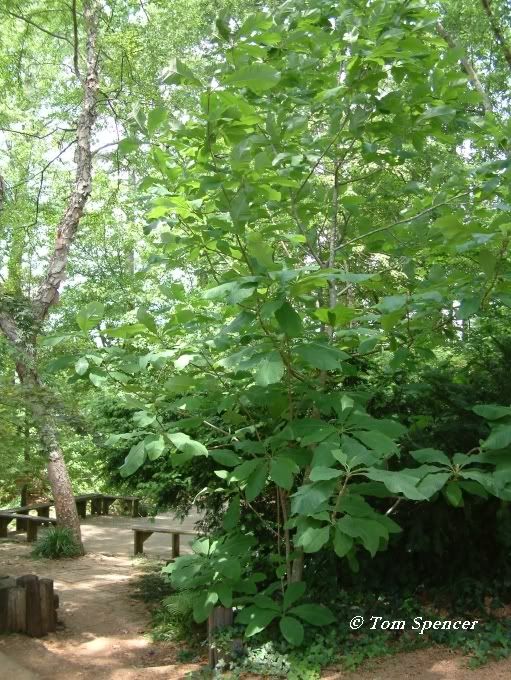 But now, 10 years later in my life, I take them in. The trees are magnolia trees and the shades of green vary from the deepest of hunter, to a light shade of mossy green and finally dull down to a peaish green color that reflects the oncoming change of season.
As I start my own “journey” through the zoo I stop and linger at the cage of the
 Black and White Ruffed Lemur. He looks me dead in the eye, not with the amusement of the monkeys I previously encountered, but with merely a “what are you looking at” expression. I sit down on a black bench and begin to absorb the environment of my lemur “friend”. There are several balls in his cage, which look like they have never enjoyed a moment of attention. Also, I pause to read his information plaque, which tells me that he is a tree dweller from Madagascar, and that he enjoys eating leaves and fruits off the rainforest canopy. The plaque goes on to describe the physical characteristics of the lemur, and the mating habits it enjoys. Also, I noticed the emblem, which codes this breed of lemur as an endangered species. I continue to eye the lemur and notice that behind his glare there seems to be a melancholic sadness in his eyes. Perhaps it is a result of his captivity.
Later, after I resume my spot on the bench, a young woman comes up next to the cage and pulls out of her bag an art book, and water colors. She begins to splash away the figure of the Black and White Ruffed Lemur. I watch her as she mixes and blends the colors in a tremendous hurry. After she is done I chance a glance at her work and label it cursory at best, for in her hurry she seemed to miss both the glare, and underlying sadness provoked by the lemur. As she walks away I wonder if this is the reason for the look I received from me lemur friend. This young woman strove to depict the lemur, without taking a second to understand it, or to try to look at it any deeper than a mere image in a cage. Her fever in producing her work stuck me as a token of the way people conduct their lives daily. Thus far I had noticed that the zoo goers were content to only gaze upon the occupants of the zoo themselves, and had little time to read the lengthy descriptive paragraphs about each animal that I found so fascinating, and even less time to linger and study the animals. I guess it is symbolic of how people spend their lives. We are in such a hurry to move from one task, event, or experience to another, or just along our daily path, that we don’t take the time to stop and look deeper into what it is we are experiencing. The inability to find time may be one of many downfalls of our culture today. It surely can not be possible for us to understand the path we take, or the things that cross it, if we can not take the time to mull things over, or to dig deep into the emotions in them.
Continuing on along the path I notice I young boy, gazing at a majestic camel. As my senses
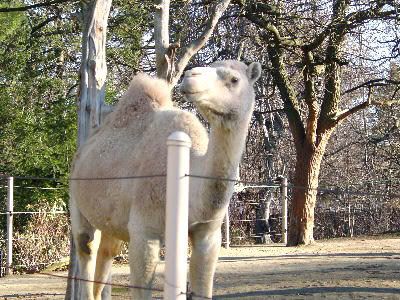 move on from the sight of a taupe headed boy dwarfed by a camel I hear the sound of his father calling to him to hurry. The boy continues to point and giggle at the humps on the camels back and the father continues to stress about his son’s, in the father’s eyes, unwarranted attention to the camel. The camel strolls over to the boy and the boy reaches out and swipes his hand across the hair covering one of the camels long lanky legs. Finally the father relents his useless efforts to distract the boy and walks over the fence and places his hand upon the camels shoulder. The two stand there, man and son, and take in the camel, and for a second, the father seems to let go of his anxiety as he murmurs to the camel, and to his son in turn.
In this instance the zoo provided for a momentary pause in the frustrations of the father, and he and his son made a memory that will probably stand for years to come. Is this the real purpose of the zoo? Maybe in this instance the man was allowed access beyond the clouded realms his world knows to an actual image of what his life is about. Life is defined by the moments we live, and what we choose to take from them. Everything I have taken in thus far leads directly back to how humans live their daily lives. Are we all just monkeys in a cage? Satisfied to look only as long as we can draw simple enjoyment from what we see, and too scared to look past the obvious and discovers something new about life, or about ourselves. Life is not a one-path journey; it is a wilderness to be explored. Staying safely on the path, as most people do, is no doubt the easiest and least risky way for us to live. Is that the right way for us to lead our lives? Wouldn’t it be better if we took the time to enjoy what life has given us, and to understand our surroundings? Henry David Thoreau once wrote:
“We live but a fraction of our life. Why do we not let on the flood, raise the gates, and set all our wheels in motion? He that hath ears to hear, let him hear. Employ your senses.”People were meant to live, not to rush around, to busy to read the plaques of life. Life is the experiences we take from it, and experiences come from knowledge, which comes from letting our guard down, and opening ourselves to something new. The zoo is only one speck of an example of how humans cut their lives short, by failing to stop and “smell the roses”, or to take anything but a clouded memory from the experience. Ought the man been more willing to stop and enjoy a moment with his son immediately rather than trying to bring the moment to a screeching stop? Surely the artist would have been better satisfied to take the time to better understand her object, for maybe then she could have captured it correctly. People should adopt the attitude of Black and White Ruffed Lemur, and gaze past the mundane and seek to understand the world, better than to merely see it. The only reason we are jumping monkeys is because it is what we choose to be.
Sunday, September 23, 2007
Post 7: Lincoln Drive
Subscribe to:
Posts (Atom)